A Small Gap and a Tall Tale: A Loose-Tooth Story Ritual with Little Red Horse
There is a particular kind of drama that arrives when a tooth starts to wobble. One minute it is business as usual at the breakfast table. The next, there is a small person prodding a molar with a tongue and announcing that something is definitely, absolutely, probably happening. For some children this is pure excitement. For others it is a low hum of worry that something familiar is about to change. Both reactions are welcome here.
At Little Red Horse, we like a milestone that can be carried in a pocket. A loose tooth is one of those lovely, ordinary, slightly strange events that deserves a story rather than a lecture. So here is a gentle ritual you can pull out when the wobble begins: a three-part tale, a tiny folded keepsake and a few phrases for the grown-up at the sink.
Start with the wobble, not the tooth
Children often cope better with a big feeling when they can give it a shape. Before you reach for explanations about roots and adult teeth, try a bit of naming. Ask what the wobble feels like today. Is it a tiny door knocking? A pea rolling about? A brave explorer testing the edge of a map? You do not need to fix the feeling. You just need to let it sit on the table between you.
This is where Little Red Horse comes in, not as a bossy instructor but as a curious companion. In our house stories, the little horse is fond of noticing things. She notices when the gate needs oiling, when a boot has gone missing and when a child is holding a feeling very tightly in one hand. A wobbly tooth is exactly her sort of mystery.
The three-part tale: Notice, Nudge, Nestle
You can tell this story in five minutes at bedtime, in the car or while someone is refusing to put on socks. It works best as a back-and-forth tale, with the child filling in the gaps. Keep it light. Nobody needs a plot twist involving pliers.
Part one: Notice
Begin with Little Red Horse finding something small and wobbly. It might be a loose fence post on the lane, a wobbly stone in the stream or a little sign swinging in the wind. The horse does not charge in. She stops, lowers her head and notices.
Ask your child: what has the horse found? How does it wobble? Is it a happy wobble, a worried wobble or a wobbly wobble that has not decided yet? Let the answer be silly. Let it be quiet. Let it change halfway through.
Part two: Nudge
In the middle of the tale, the wobbly thing needs a gentle nudge. Not a yank. Not a shout. A nudge might be a kind word, a patient wait, a friend standing nearby or a grown-up saying, I can stay while you decide. The horse tries one small thing, then another, and discovers that wobbling is often just a sign that something is getting ready.
This is the useful bit for real life. You are not telling your child that losing a tooth is nothing. You are telling them that small changes can be met with small, steady kindness. If your child offers a worry, pop it into the story. The horse can be worried too. The horse can also be a bit dramatic. Both are allowed.
Part three: Nestle
End with the gap. In the tale, the wobbly thing finally settles somewhere new. Perhaps the fence post becomes a marker for a tiny garden. Perhaps the stone becomes a doorstep for a beetle. Perhaps the little sign now points to a bench where the horse likes to rest. The point is not that something has vanished. The point is that there is a new space, and the space has a story in it.
For a child, this can be a gentle way to imagine the gap in their smile without making it scary. They might decide the gap is a tiny cave, a window, a whistle-hole or a place where a new tooth is busy doing important growing. Let them choose.
A folded-paper keepsake for the pocket
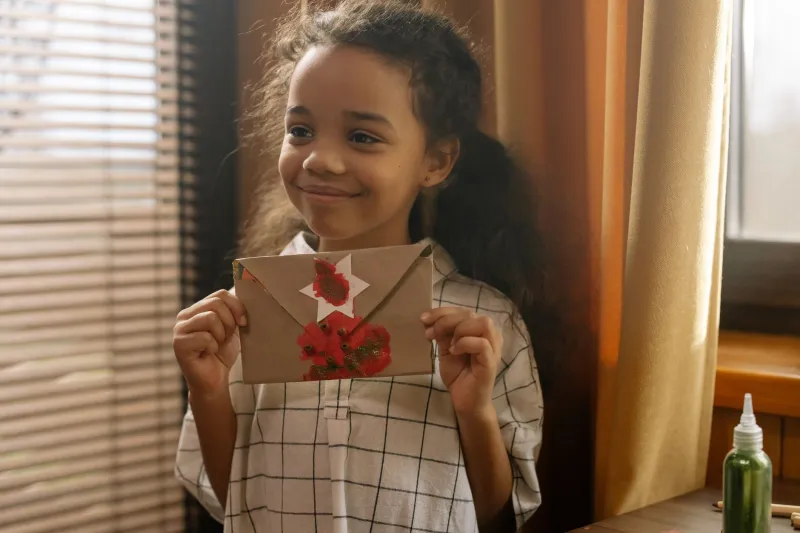
If your child likes something to hold, make a tiny story pocket. You need a square of paper, a pencil and about two minutes. An old envelope works well. So does a page from a notebook, cut roughly square.
- Fold the paper in half to make a triangle, then fold it again to make a smaller triangle.
- Open it out and draw one small thing on the paper: a tooth shape, a horse, a gate or a simple circle. Add one word underneath, such as wobble, brave, waiting or nearly.
- Fold the paper back up into a small square pocket. Tuck the flaps in so it stays shut.
- Write your child's initials on the outside, or let them draw a tiny star.
This is not a tooth fairy substitute and it is not a medical object. It is just a pocket-sized bit of story. Some children will want to keep it under their pillow. Some will post it into a coat pocket and forget it entirely, which is also fine. The making is the ritual. The keeping is optional.
Words for the grown-up at the sink
When the wobble turns into a wail, it helps to have a few phrases ready that do not begin with be brave. Try these instead:
- I can see it feels strange. You can tell me about the strange bit.
- Your tooth is doing a job, and your mouth is getting ready for a new one.
- We do not have to wobble it right now. We can just notice it together.
- You can feel wobbly on the inside and still be safe on the outside.
- Would you like a story about it, or would you like a quiet sit?
Avoid the urge to promise that it will not hurt, because you cannot know that. Avoid teasing, too, even the affectionate kind. A loose tooth can make a child feel suddenly aware of their own body, and a little dignity goes a long way. If your child is worried about pain, bleeding or a tooth that seems stuck, speak to your dentist. A story ritual is a lovely companion to good care, not a replacement for it.
Make it a ritual, not a performance
The best thing about this little ceremony is that it does not need to be perfect. You do not need a special notebook or a candle or a child who sits beautifully still. You need a wobbly tooth, a willing storyteller and about five minutes. Start with the same opening line each time: Little Red Horse found something wobbly today. Then see where the tale takes you.
When the tooth finally comes out, you might tell the third part again, just to mark the gap. You might make another paper pocket. You might simply say, there it is, a small gap and a tall tale. Either way, you have given your child a way to hold a big feeling in a small, manageable story. And that is rather a lovely thing to keep in your pocket.