The Pocket-Sized Goodbye: A Three-Line Story Swap for School-Gate Wobbles
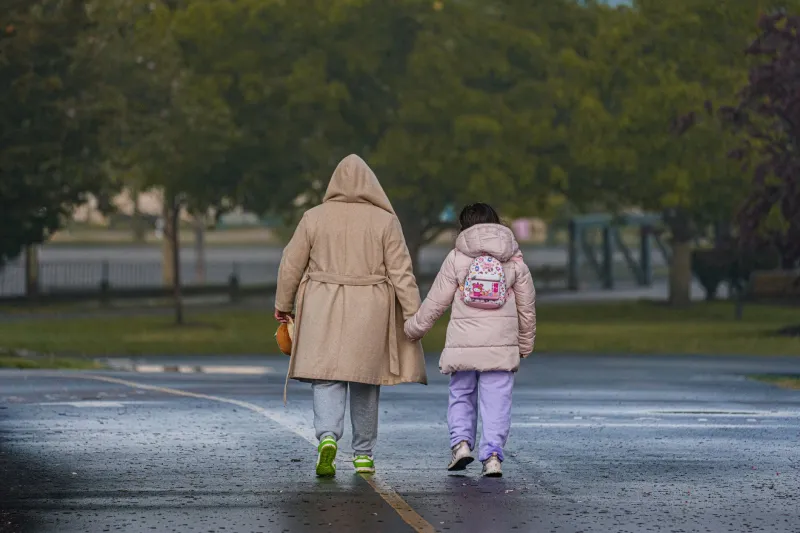
School mornings can be a lot. There is the hunt for the missing shoe, the sudden dislike of a once-favourite cardigan, and the small person who was perfectly cheerful until the gate came into view. The school gate is a hinge between home and the wider world, and hinges can squeak. A story swap will not fix every wobble, but it can give a child something to hold on to as they step through.
At Little Red Horse, we like rituals that are small enough to survive real life. This one takes about five minutes, needs no props, and can be done in wellies, in a car, or halfway through a nursery corridor. It is not a performance and it is not a test. It is just a little pocket of connection before the day begins.
Why a story swap helps at the gate
Drop-off is a transition, and transitions feel safer when they have a shape. A predictable three-line routine tells a child what is happening next without a long, anxious explanation. It also gives the grown-up somewhere to put their own hurry. Instead of saying, 'Right, off you go,' you both pause for a moment and trade something imaginative.
The key is to keep it light. This is not the moment for a detailed discussion about feelings, although feelings are welcome. It is a tiny story ritual: a beginning, a middle and a goodbye. The same shape every time makes it reassuring. The different details keep it interesting.
The three-line ritual
Think of it as three short lines, one from each of you, and one tiny tale to finish.
-
The leaving line. The grown-up says one small, specific thing they will be doing while the child is at school. Not 'I will miss you terribly,' which can feel heavy, but something ordinary and warm: 'I will put the washing on and think about what we are having for tea.' This gives the child a picture of home carrying on.
-
The return line. The child says one thing they would like to do or tell you at pick-up. It might be 'I want to tell you about the paint' or 'I want to show you my new sticker.' If they cannot think of anything, offer a gentle prompt: 'Shall we look for one interesting leaf on the way home?' The return line is a small promise that the day has an ending you will share.
-
The tiny tale line. You each add one sentence to a story you are building together. It can be the same story all week, or a new one each morning. The only rule is that it must be short enough to finish before the bell.
Three simple story prompts
If you are not sure where to start, these three prompts work for most ages and most mornings.
-
The pocket pebble. 'Tell me one thing your pocket pebble will see today.' The child invents a tiny pebble in their pocket, and the pebble becomes a quiet observer of the school day. It might see the register, the climbing frame or a dropped glove. At pick-up, ask what the pebble saw.
-
The doorway dragon. 'What is the dragon at the gate going to do today?' The dragon might be sleepy, helpful, or busy guarding a patch of playground. This one is good for children who like a bit of comedy with their courage.
-
The returning ribbon. 'What colour ribbon shall we tie to the day?' The child chooses a colour, and you both imagine it tied to something they will come back to: the classroom door, the coat peg, the lunchbox. At home time, the ribbon is untied and the day is finished.
A micro-tale for the walk: The Little Red Horse and the Pocket of Courage
Little Red Horse was waiting by the school gate one November morning when she saw a small person with a very big lip wobble.
'My pocket feels empty,' said the small person.
Little Red Horse looked at the pocket. It did look empty, but empty is not the same as nothing. She leaned close and breathed a warm horse breath into it. 'There,' she said. 'One pocket of courage. It has a steady hoofbeat inside, and a tiny whinny, and one soft huff for when the corridor feels too loud.'
The small person put a hand in their pocket. They could not feel anything, exactly, but they could imagine it. The hoofbeat went thud, thud, thud. The whinny was very small. The huff was warm.
'Will it run out?' asked the small person.
'No,' said Little Red Horse. 'Courage does not run out. It just gets a bit shy. Tap the pocket and it remembers itself.'
At pick-up time, the small person came out with a leaf in one hand and a smudge of paint on the other. 'The courage worked,' they said. 'It only got shy at lunch.'
Little Red Horse nodded. That, she thought, is exactly how courage works.
Adapting it for nursery, childminders and rushed mornings
The ritual can shrink or stretch. For a nursery run, use just the leaving line and the return line. 'I will come back after snack time, and you can tell me about the sandpit.' For a childminder drop-off, try a special wave that belongs only to you both, plus one sentence of story. The wave becomes the ritual when words feel too big.
For rushed mornings, do it in the car or on the bus. Keep the three lines but make them shorter: 'I will post a letter. You will tell me about the bricks. The dragon is wearing a hat.' That is enough. The point is not the length. The point is the shape.
If your child is very upset, do not abandon the ritual, but do not drag it out either. Name the feeling simply, repeat the return line, and go with a warm, ordinary goodbye. A long, anxious farewell can make the gate feel heavier. A short, confident one says: I trust that you can do this, and I will be back.
Keeping it fresh without turning it into a performance
Rotate the prompts every week or so, or let your child choose. Some children will want the same story for a month, and that is fine. Repetition is the point. Others will want to invent a new character every morning, which is also fine. The grown-up's job is to hold the shape, not to direct the show.
Try not to turn the story swap into a quiz about the day ahead. It is not a rehearsal for school; it is a small bridge between home and the gate. A bridge does not need to be clever. It just needs to be there.
As the autumn term heads towards its final stretch in 2026, the mornings may get darker and the coats may get thicker, but the ritual can stay the same. Three lines, one tiny tale, and a pocket of courage. It is a small thing to carry, which is exactly why it works.