Twelve Minutes of Torchlight: A Christmas Eve Walk That Ends With a Story
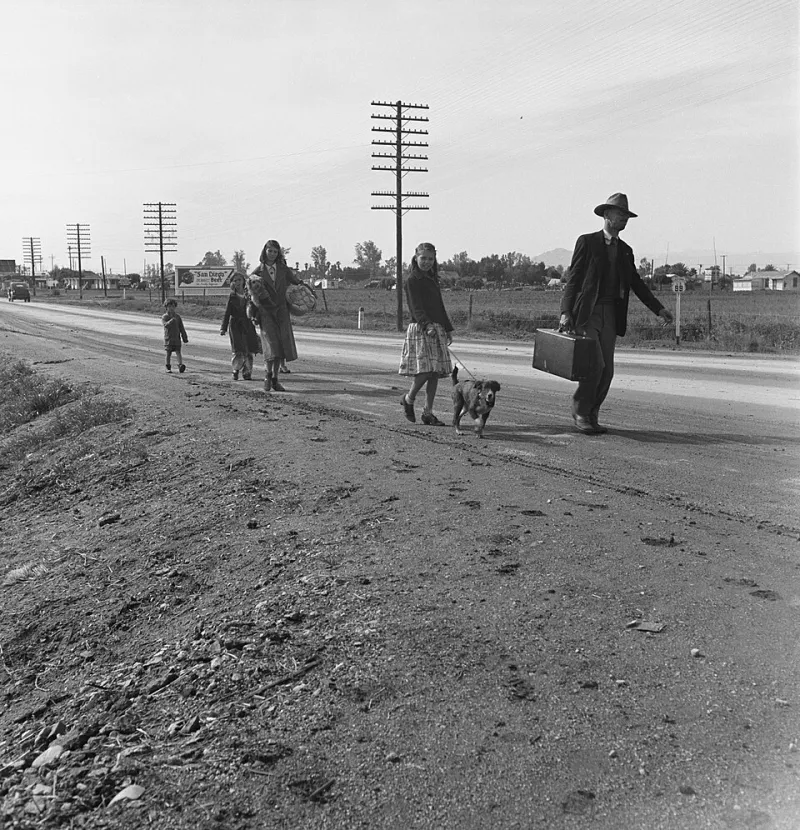
Photo: Dorothea Lange, Public domain, via Wikimedia Commons
There is a particular hour on Christmas Eve when the house becomes unbearable in the best way. The stockings are hung too early. Someone has eaten the good cheese. A child has asked, for the eleventh time, whether it is nearly time. Nobody can settle, and nobody really wants to.
That hour is not a problem to be solved. It is a gap in the day, and a gap in the day is where traditions get made.
Our suggestion is small and slightly old-fashioned: put on your coats and go for a walk. Not a long one. Not a drive to a beauty spot with a car park and a queue. Just twelve minutes of torchlight around the streets you already know, ending with a story at your own front door.
Why Christmas Eve suits walking
The streets are doing half the work for you. On Christmas Eve, ordinary things look staged. Windows glow. Bin bags sit out looking oddly ceremonial. Somebody's wreath is slightly wonky and therefore perfect. The air smells of cold and, if you are lucky, of someone else's wood burner.
Children notice this more than we do. A walk they would refuse in July becomes an expedition in December, purely because it is dark and they have been allowed to hold a torch.
And here is the quiet bit of magic: anticipation is easier to carry when your legs are moving. A child who is climbing the walls at 5pm will often walk happily for ten minutes and come home noticeably calmer. It is not a cure for excitement. It is somewhere to put it.
The route: short, familiar, slightly altered
You do not need a plan. You need a loop.
Choose the shortest circuit you can think of — round the block, down to the corner and back, along the alley behind the houses if it feels safe and lit. Aim for ten to fifteen minutes at small-leg walking pace. If your child is three, aim for eight and be pleasantly surprised.
The one rule: go the wrong way round. Turning left instead of right at the end of your road is enough to make a familiar street feel like a different country. Children narrate unfamiliarity. That is the whole point.
The tale of the little red horse and the lantern
Save this for the turnaround point — the moment you turn for home. Gather everyone close, keep one torch low so faces are lit softly rather than dazzlingly, and tell it plainly. It takes about ninety seconds.
Once, on a night when the stars came out early, Little Red Horse trotted down a lane with a lantern held gently in her teeth. She was delivering something to a house at the end of the lane, though she would not say what.
At the first gatepost she stopped and listened. Inside, someone was humming a carol slightly out of tune. She liked that, so she took it with her.
At the second gatepost she stopped again. There was the smell of oranges and something baking. She took that too.
At the third gatepost she stopped a third time, because she could hear a small person breathing very hard, the way you do when you are pretending to be asleep and not doing it very well.
Little Red Horse pushed the gate open with her nose, breathed a warm cloud onto the window, and let herself in. And when the small person asked what was in the lantern, she said: nothing at all. The lantern was only for showing the way. The story had been walking beside her the whole time.
Then walk home. That's it. No punchline required.
Five sensory prompts to hand out along the way
Give each child one or two, not five. Prompts work best when they feel like a secret rather than a quiz.
- The listening one: can you hear anything that isn't a car? (Carols, a telly through a wall, a gate, a distant train.)
- The counting one: how many different-coloured front doors can you spot by torchlight?
- The smelling one: find the street that smells most like Christmas. Compare notes at the corner.
- The noticing one: which house has gone the most overboard? Be generous in your marking.
- The wishing one: whisper one thing you're looking forward to tomorrow into the cold air and watch it disappear.
Practicalities for tired parents
Keep it short and don't apologise for it. Twelve minutes is a proper tradition. Ninety minutes is a logistics operation.
One adult at the back. Always. Children walk faster when someone is behind them, and it stops the straggler feeling like a straggler.
Soften the beam. A square of red cellophane and an elastic band over the torch turns a searchlight into a lantern and saves everyone's night vision. Also, frankly, it looks lovely.
Take a thermos. Hot chocolate, lid screwed on tight, one small cup passed round at the turnaround point. This is the bit they will remember in twenty years, and it costs almost nothing.
Decide the ending before you leave. The walk finishes at your door, not at the end of the street, and not with 'just one more loop'. Say it at the start. Children accept a boundary they were warned about far more readily than one that appears from nowhere.
Have the pyjamas ready and the kettle on. Coming home cold into a warm house is one of the great physical pleasures. Lean into it. Straight into pyjamas, story, bed.
If it rains
Go anyway, briefly, and come back. Six minutes in drizzle with a torch and a small horse story is still a tradition. The point was never the weather. The point was that on the longest-feeling evening of the year, you went out together and came back to a warm house with something to tell.
And next year, you'll only have to say two words — torch walk — and the whole thing will come back, boots and all.